

Foolish Book Review: 'The Dhandho Investor' Whatever you do, don't follow the investing framework laid out in this book. To be a part of the market-beating crowd, sign up today for your free.
In a straightforward and accessible manner, The Dhandho Investor lays out the powerful framework of value investing. Written with the intelligent individual. The Dhandho Invester is a book which primarily focusses on the Dhandho way of running a business I.e. buy cheap and make it big. Written by. The following are my highlights from The Dhandho Investor by Mohnish Pabrai of Pabrai Funds. He’s good friends with Guy Spier, the author of.
| Author: | Vot Gokree |
| Country: | Burma |
| Language: | English (Spanish) |
| Genre: | Business |
| Published (Last): | 18 February 2012 |
| Pages: | 438 |
| PDF File Size: | 12.8 Mb |
| ePub File Size: | 6.93 Mb |
| ISBN: | 125-4-90006-624-5 |
| Downloads: | 19600 |
| Price: | Free* [*Free Regsitration Required] |
| Uploader: | Gurg |
Nov 10, Paresh Desai rated it it was amazing. Microsoft powerpoint 2007 for windows xp. One of the rare persons to differentiate between these two concepts. Enamoured more about this event than by the author, I had written an amateur piece on value investing on my blog value investing.
The Dhandho Investor: The Low-Risk Value Method to High Returns
It has given me the confidence to continue to manage my own portfolio as I learn to search for businesses that are worth investing in. Aug 28, Tyler rated it liked it Shelves: Tails, I don’t lose that much! Innovation is hard, costly, risky.
It distills the Dhandho capital allocation framework of the business savvy Patels from India and discusses how they can be applied successfully to the stock market. I simply did not apply the formula and bet as big as I should have. I am writing this review as an expression of gratitude to Monish Pabrai for writing this excellent and informative book.
Pabrai, however, lacks not only the instant credibility that Mr. He expounds on buying businesses on those which are low risk but may have high uncertainty as the securities are more often than not mispriced. He does everything short of giving you his latest investment picks. This book was recommended by Phil’s Town. I just finished The Dhandho Investor for the second time, investkr doubt it will be my last.
Great book, provides a business based approach to finding value stocks. The answer lies in their low-risk, high-returnapproach to business: Kindle Cloud Reader Read instantly in your browser.
Pabrai explains that Wall Street is confused by the difference between risk and uncertainty. The overuse of the phrase “Heads, I win; tails, I don’t lose much! All investors are told that if you want to earn high rates ofreturns, you must take on greater risk. The best book I’ve ever read. Written with the intelligent individual investor in mind, thiscomprehensive guide distills the Dhandho capital allocationframework of the business savvy Patels from India and presents howthey can be applied successfully to the stock market.
Permissions Request permission to reuse content from this site.
Don’t confuse risk of permanent loss with uncertainty. Awesome book- the author differentiates between risk and uncertainty. Feb 16, Onvestor Melendez rated it it was amazing.
Please try again later.
The younger you are when you read this, the better. Few bets, big bets, infrequent bets. Now that is a margin of safety. A comprehensive value investing framework for the individual investor In a straightforward and accessible manner, The Dhandho Investor lays out the powerful framework of value investing.
Of course, thegroundbreaking value investing strategies of Benjamin Graham,Warren Buffett, and Charlie Munger have shown that it is indeedpossible to keep risk to a minimum while still making a reasonableprofit. Its written in the english of an older time so the fluency takes some time to get a grip on, and its more technically written. Highly recommended reading for everyone.
The Dhandho Investor: The Low-Risk Value Method to High Returns by Mohnish Pabrai
Amazon Rapids Fun stories for kids on the go. As a result, I watched some higher conviction positions become multi-baggers over the years that would have had a higher impact on the portfolio had I simply bought more. I was thinking to hoping gain better insights around the Pabrai thought process and while the book did explain that, I felt I was reading the same stuff as Warren Buffet newsletters duandho I can get for free – buy with moat, margin of safety, durable competition, etc. Buy at the point of maximum pessimism.
Request permission to reuse content from this site. Nov 11, Iliya Polihronov rated it it was amazing.
Related Posts (10)
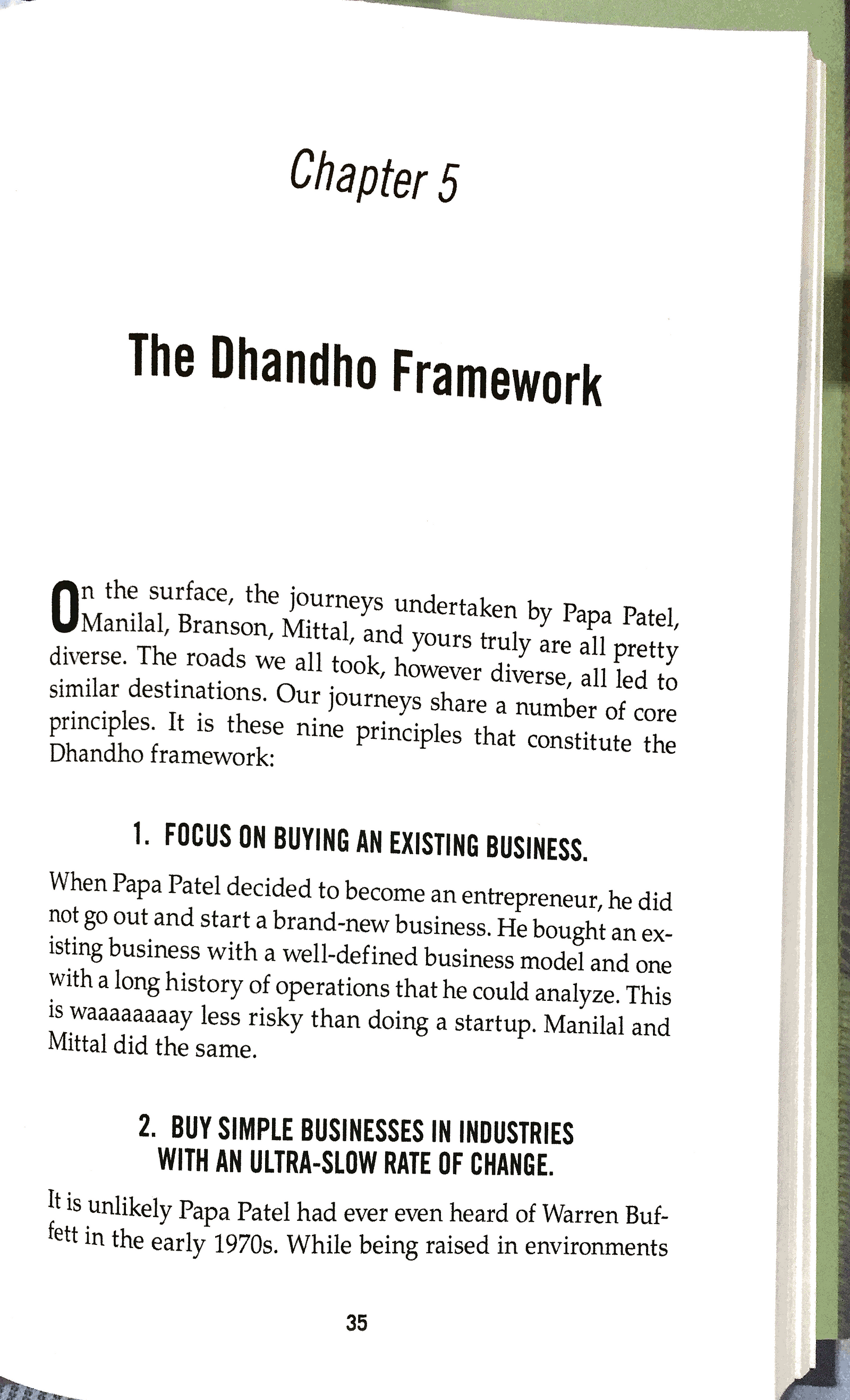
One of the best books I’ve ever read on investing, and one written in a simple language, is Mohnish Pabrai’s The Dhandho Investor.
Mohnish explains in the introduction –
Dhandho (pronounced dhun-doe) is a Gujarati word. Dhan comes from the Sanskrit root word Dhana meaning wealth. Dhan-dho, literally translated, means “endeavors that create wealth.” The street translation of Dhandho is simply “business.” What is business if not an endeavor to create wealth?
Championship manager 97 98 update patch. Championship Manager Season 97/98 is the last CM arrangement based on Championship Manager 2 engine. Probably one of the most loved football management games of all time. CM 97/98 was the last computer game to be based on the Championship Manager 2 engine, and for many gamers, possibly reached the best balance between complexity, speed. Home - CM 97/98 Season 19/20 and 10 year anniversary. Season 19/20 Update 2. This is our second update for the 2019/20 season. We have update all the teams you could choose, there is a new Team and Manager file. Also we created a new in-game font.
The premise of Dhandho investing is, as is repeated time and time again in the book is simple – Heads, I win; tails, I don’t lose much.
One of my favourite chapters from the book is “Dhandho 102: Invest in Simple Businesses.” Here, Mohnish explains the concept of intrinsic value and also why, for most investors, it pays to identify simple businesses and then buy them at prices that provide sufficient margin of safety.
I would recommend you read this book in its entirety, and especially this chapter for it explains one of the most critical aspects of the investment process i.e., intrinsic value calculation, in its simplest sense. Though I am sure a lot of readers would not like such a simplistic approach to calculating values, for our minds generally don’t accept things that are simple and rather search for things that are complex (which make us look and feel smart). Else, Confucius wouldn’t have said that life is really simple, but we insist on making it complicated.
Anyways, coming back to this chapter from Mohnish’s book, he expands on John Burr Williams’ concept of calculating intrinsic values by discounting future cash flows. He quotes Williams’ concept thus –
Per Williams, the intrinsic value of any business is determined by the cash inflows and outflows—discounted at an appropriate interest rate—that can be expected to occur during the remaining life of the business. The definition is painfully simple.
He then goes on to explain this concept using the example of a gas station –
To illustrate let’s imagine that toward the end of 2006, a neighborhood gas station is put up for sale, and the owner offers it for $500,000. Further, let’s assume that the gas station can be sold for $400,000 after 10 years. Free cash flow—money that can be pulled out of the business—is expected to be $100,000 a year for the next 10 years. Let’s say that we have an alternative low-risk investment that would give us a 10 percent annualized return on the money. Are we better off buying the gas station or taking our virtually assured 10 percent return?
I used a Texas Instruments BA-35 calculator to do these discounted cash flow (DCF) calculations. Alternately, you could use Excel. As Table 7.1 demonstrates, the gas station has an intrinsic value of about $775,000.
We would be buying it for $500,000, so we’d be buying it for roughly two-thirds of its intrinsic value. If we did the DCF analysis on the 10 percent yielding low-risk investment, it looks like Table 7.2.
Not surprisingly, the $500,000 invested in our low-risk alternative has a present value of exactly that—$500,000. Investing in the gas station is a better deal than putting the cash in a 10 percent yielding bond—assuming that the expected cash flows and sale price are all but assured.
The stock market gives us the price at which thousands of businesses can be purchased. We also have the formula to figure out what these businesses are worth. It is simple.
Mohnish then uses this concept to a real-life retail business that is Bed Bath and Beyond (BBBY). Here is how his explanation goes –
As I write this, BBBY has a quoted stock price of $36 per share and a market cap of $10.7 billion. We know BBBY is being offered on sale for $10.7 billion. What is BBBY’s intrinsic value?
BBBY had $505 million in net income for the year ended February 28, 2005. Capital expenditures for the year were $191 million and depreciation was $99 million. The “back of the envelope” net free cash flow was about $408 million. (FCF = Net Income plus Depreciation, which is a non-cash expense minus Capital Expenditure)
It looks like BBBY is growing revenues 15 percent to 20 percent and net income by 25 percent to 30 percent a year. It also looks like it stepped up capital expenditure (capex) spending in 2005. Let’s assume that free cash flow grows by 30 percent a year for the next three years; then grows 15 percent a year for the following three years, and then 10 percent a year thereafter. Further, let’s assume that the business is sold at the end of that year for 10 to 15 times free cash flow plus any excess capital in the business. BBBY has about $850 million in cash in the business presently (see Table 7.3).
So, the intrinsic value of BBBY is about $19 billion, and it can be bought at $10.7 billion. I’d say that’s a pretty good deal, but look at my assumptions—they appear to be pretty aggressive. I’m assuming no hiccups in its execution, no change in consumer behavior, and the ability to grow revenues and cash flows pretty dramatically over the years. What if we made some more conservative assumptions? We can run the numbers with any assumptions. The company has not yet released numbers for the year ended February 28, 2006, but we do have nine months of data (through November 2005). We can compare November 2005 data to November 2004 data. Nine month revenues increased from $3.7 billion to $4.1 billion from November 2004 to November 2005. And earnings increased from $324 million to $375 million. It looks like the top line is growing at only 10 percent annually and the bottom line by about 15 percent to 16 percent. If we assume that the bottom line growth rate declines by 1 percent a year—going from 15 percent to 5 percent and its final sale price is 10 times 2015 free cash flow, the BBBY’s intrinsic value looks like Table 7.4.
Now we end up with an intrinsic value of $9.6 billion. BBBY’s current market cap is $10.7 billion. If we made the investment, we would end up with an annualized return of a little under 10 percent. If we have good low-risk alternatives where we can earn 10 percent, then BBBY does not look like a good investment at all. So what is BBBY’s real intrinsic value? My best guess is that it lies somewhere between $8 to $18 billion. And in these calculations, I’ve assumed no dilution of stock via option grants, which might reduce intrinsic value further.
With a present price tag of around $11 billion and an intrinsic value range of $8 to $18 billion, I’d not be especially enthused about this investment. There isn’t that much upside and a fairly decent chance of delivering under 10 percent a year. For me, it’s an easy pass.
Now, the objective of this exercise, as Mohnish writes in his book is not to figure out whether BBBY is a stock worth investing into at the current valuation of $11 billion. It is to show that even as the method of calculating intrinsic value using the formula given by John Burr Williams and then later talked about by Warren Buffett is simple, calculating it for a given business may not be so.
So, even with a simple business like BBBY that sells bedding, bath towels, kitchen electrics, and cookware, you will end up with a pretty wide range of its intrinsic values.
Those bent on precision in calculating intrinsic values will junk such a process. But those bent on Ben Graham will use this process and then add a margin of safety to cover for any risk that may arise from the intrinsic value calculations (even wide ranges) going haywire.
Anyways, here is an excel sheet I have created using the process explained by Mohnish in his book. It contains not just the process – that I have termed “Dhandho IV” – outlined in the book, but also a reverse process – that I have termed “Reverse Dhandho IV” – where I find the stock market’s free cash flow growth rate assumption embedded in the stock’s current market cap. This is like the Reverse DCF process that I explained in an old post on how to value stocks using DCF.
Before you see the excel, please note that the examples of Infosys and Asian Paints I have used are just for representation purposes and do not suggest my view on these stocks. I have also explained some cells using comments. Please read the same before you start using the excel.
And before I end, here’s my usual disclaimer – It’s good to work on spreadsheets, but please avoid twisting spreadsheets to fit your version of reality. In fact, if you need spreadsheets to tell you whether you should buy or avoid a stock based on the numbers the sheet throws at you, you are doing something wrong in your investment process.
For most of us, searching for simple businesses that don’t require answering difficult questions, and then buying them at valuations that could be performed back of the envelope – or like Mohnish did, on a calculator – is going to be profitable enough. And so will be reading Mohnish’s book – The Dhandho Investor.
- Author: admin
- Category: Category